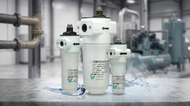
Compressed Air Filtration Stages: Coalescing, Part…
Posted by AVP on Sep 15th 2026
Oil streaks in a fresh paint job. A desiccant bed that turns to mush a year into a three-year life. Air cylinders that stick because a flake of pipe scale worked into a port. Those failures almost always trace back to compressed air filtration that either isn't there or sits in the wrong order on the line. The fix rarely involves touching your compressor. Put a moisture separator ahead of your filters, catch bulk oil with a coarse coalescing element before the air ever reaches the dryer, then finish with a fine element matched to what the end use actually demands. Customers who rebuild their filter train in that sequence tell us element changes stretch out and downstream repairs slow way down. Stay with us and we'll break down what each stage pulls out of the air and how to pick a grade without guessing.
What Each Stage of Compressed Air Filtration Is Actually Removing
Four different contaminants ride along in a plant air line, and no single element catches all four. Bulk liquid water drops out the moment the air cools. Oil aerosol slips straight through a mesh screen. Oil vapor behaves like a gas and ignores anything mechanical. Then the solids: rust, pipe scale, compressor wear metal, desiccant fines.
Good compressed air filtration handles them heaviest to lightest, because every stage exists to protect the one behind it. Air leaves the compressor, settles in the receiver, cools through an aftercooler, and dumps most of its free water in a moisture separator. A coarse coalescing element takes the bulk oil next. Then your air dryer, deliquescent or regenerative depending on the dew point you need, with a general purpose element on the outlet to catch whatever that dryer sheds.
Skip a stage and the next one pays for it. Feed saturated air into a high efficiency element and it floods, differential pressure climbs, and you're replacing a cartridge that should have run for months. Run a regenerative dryer with no oil removal ahead of it and the desiccant coats over, dew point creeps up, and the dryer takes the blame for a filtration problem.
Coalescing Filters
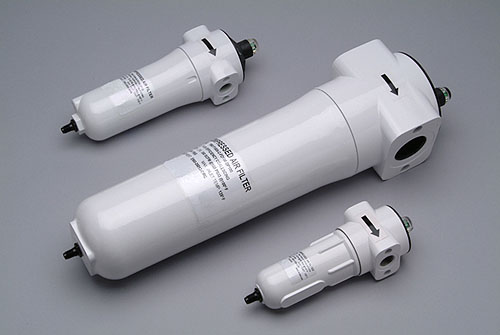
A coalescing filter doesn't strain oil out of the air. Oil aerosol droplets are far too small for that. Air flows from the inside of the element outward through multiple layers of borosilicate fiberglass media, and the droplets collide with those fibers, merge with each other, and grow heavy enough that gravity pulls them into a polyester drainage layer and down to the sump.
Grade selection at this point in your compressed air filtration line decides everything downstream. Grade A handles 5 micron coarse duty at 3.9 PPM oil carryover. Grade B is the general purpose workhorse, 1 micron at 99.99% efficiency and 0.78 PPM carryover. Grade C is the high efficiency element: 0.01 micron, 99.9999% at 0.6 micron, and just 0.008 PPM oil left in the stream.
Watch two numbers when you spec these. Clean pressure drop runs 0.50 PSI on a Grade A element and 1.50 PSI on a Grade C, and every PSI costs you compressor horsepower. Maximum inlet temperature tightens as the grade gets finer, 175°F for Grade B and 125°F for Grade C, so a hot line off an underperforming aftercooler will cook a fine element. Staging beats jumping: a Grade A ahead of a Grade C means the fine element only sees what the coarse one missed.
Particulate Filters
Here's the detail that trips people up. A particulate filter uses the same housing and looks nearly identical, but the air travels the other way, outside to inside, so solids collect on the outer surface of the media. Grades run parallel to the coalescing series: RAA at 25 micron, RA at 5, RB at 1 micron, and RC at 0.01 micron for high efficiency duty. All four hold up to 225°F inlet air.
The spot most plants leave empty is directly downstream of a desiccant dryer. Regenerative dryers shed fines as the beads tumble and abrade, and those fines head straight for your instrumentation. Grade RB is the standard pick for air cylinders, air motors, pneumatic conveyors, and instrument lines, with RC where the tolerance is tighter. Abrasive blasting and pulse air dust collectors lean on coarse RA and RAA elements. Industrial filtration on a large line, say 5,000 SCFM or more, usually means a carbon steel ASME housing holding eight to thirty-two elements in parallel.
Activated Carbon Filters
Coalescing and particulate elements both work on things you can physically capture. Oil vapor isn't one of them. It passes through in the gas phase, so air leaving a high efficiency coalescing element can test clean and still carry a hydrocarbon odor into a packaging room. An activated carbon filter, a Grade RD vapor adsorbing element, adsorbs those molecules and brings oil carryover down to 0.004 PPM.
Three rules govern this stage, and we bring them up with every customer who orders one. Never install a carbon element in oil-saturated air, because it saturates fast and stops working with no warning. Keep inlet temperature at or below 80°F, since adsorption falls off as the air warms. Replace the element at least every six months no matter what the pressure differential reads, because a spent carbon bed shows no rise in pressure drop the way a plugged particulate element does. Food and beverage plants, odor-sensitive packaging, and any process where air contacts product should run RB, then RC, then RD in series.
Sizing a Compressed Air Filtration Line Without Guessing
Rate the filter at the pressure it will actually see, not at 100 PSIG out of habit. Capacity rises with line pressure, and a housing rated 100 SCFM at 100 PSIG carries 231 SCFM at 250 PSIG. That one check keeps people from buying two sizes too large. Cast aluminum housings cover 15 to 1,250 SCFM with 1/4" through 3" NPT connections.
Carbon steel ASME housings pick up from there, 500 to 5,000 SCFM inline, and reach 20,000 SCFM in models with a primary sump chamber that separates bulk liquid on its own and removes the need for a liquid separator upstream. Add a pop-up or dial differential pressure indicator to every housing so element changes run on data instead of the calendar. Compressed air quality that holds year after year depends on someone knowing when a filter is loaded.
Not all of this stays on the air side, either. The same cast aluminum housings and element grades are approved for hydrocarbon service, which makes them practical filters for natural gas, instrument gas, blanketing, and pipeline purging.
Give us your flow rate, line pressure, operating temperature, and what the air touches at the end of the run, and we'll lay out the compressed air filtration stages your system needs, size each housing, and tell you which grades to keep on the shelf.