Why Clinical Air Changes When You Look at a 26 Gal…
Posted by AVP on Apr 17th 2026
A 26 gallon air compressor in a healthcare or dental setting doesn’t sit quietly in a corner doing background work. It directly influences patient care, infection control outcomes, equipment reliability, and regulatory exposure.
Some facility managers and clinical engineers mistakenly assume their systems are adequate simply because they remain operational. That mindset holds in industrial setups like an air compressor for garage use, but clinical environments don’t give you that margin.
Why a 26 Gallon Air Compressor Changes How We Treat Clinical Air Systems
In a healthcare setting, compressed air powers respiratory devices, dental handpieces, lab instruments, and pneumatic controls. That shifts how we evaluate a 26 gallon air compressor. A portable air compressor doesn’t face the same demands.
NFPA 99 outlines expectations for medical gas systems, including monitoring and alarm requirements tied to air quality. ISO 8573 1 defines compressed air purity classes based on particles, water, and oil. Those standards exist because contamination is measurable and carries real consequences.
At some point, the focus shifts. Capacity stops mattering. Control takes over. Air delivery isn’t just about volume. It’s about consistency. That’s where understanding CFM air compressor ratings matters. You’re not just asking how much air it delivers, but whether it delivers clean, dry, and stable air under varying demand.
For facility managers, this means air systems deserve the same oversight as sterilization systems. For infection control officers, it means looking past surfaces and into utility pathways.
And for administrators, it comes down to one question. Can we prove the air quality at the point of use?
Oil Aerosols Still Exist Even With Smaller Systems
Oil contamination discussions usually stay in manufacturing. In healthcare, they tend to get overlooked, especially when smaller systems like a mini air compressor or electric air compressor are involved.
Oil-injected systems can introduce microscopic oil aerosols into downstream piping. Technicians miss maintenance, or they install undersized filters. Breakthrough follows. ISO 8573 1 defines limits for total oil content because even small amounts matter.
That’s why many facilities lean toward an oil-free air compressor setup. Removing oil from the compression process eliminates one contamination source entirely. It doesn’t remove the need for filtration, but it simplifies risk management.
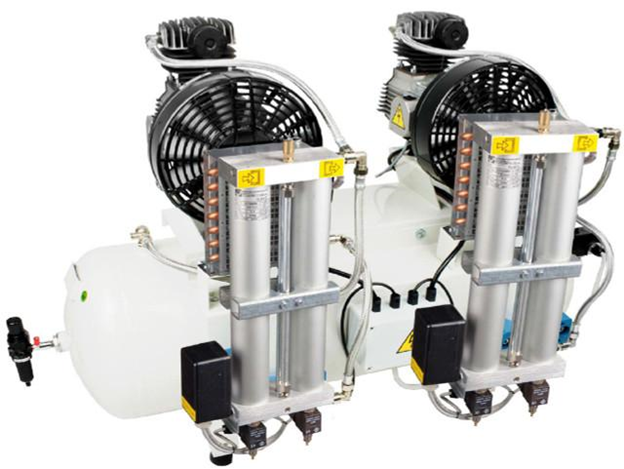
When we talk about real-world applications, 26 gallon air compressors like the PC3x2/100, Panther Oil Free Mini Air Compressor and PC2x2/100, Panther Oil Free Mini Air Compressor come into play. These units stay compact and oil-free. Teams build them for environments where purity comes first.
The Panther air compressor line fits well in dental and clinical setups where space, noise, and contamination risks all intersect. It behaves very differently from a standard air compressor for garage setup because the expectations are completely different.
Moisture Is Where Mechanical Risk Turns Into Microbial Risk
Most teams treat moisture in compressed air systems as a corrosion issue. In healthcare, it shifts into a microbiological concern.
Elevated moisture supports microbial survival. Inside any system, including a 26 gallon air compressor, moisture accumulates in tanks and piping. When condensate isn’t drained properly, it creates a stagnant environment where biofilm can develop.
Engineers start evaluating air compressor tank size differently at this point. A larger tank holds more air, but it also holds more condensate if not managed properly. That changes how often drains need to be checked and how aggressively moisture needs to be controlled.
Midway through system operation, moisture buildup starts to show. That’s when compressed air dryers stop being optional. They become control points. Whether paired with a stationary system or a portable air compressor, dryers stabilize dew point and reduce conditions where microbial growth thrives.
Dew Point Drift Happens Quietly
Dew point drives condensation behavior, but most clinicians never see it.
ISO standards define water classes using pressure dew point thresholds. Monitoring exists because moisture excursions are early warning signs. The issue is drift.
Over time, desiccants saturate. Sensors lose calibration. Load conditions change. A system may report one dew point while delivering another.
In a 26 gallon air compressor setup, especially when paired with compact dryers or mini systems, this becomes harder to detect because the system feels stable. It runs. It delivers air. But the internal conditions may be shifting.
That’s where material selection matters. We work with activated alumina, silica gel, and molecular sieve desiccants. Molecular sieve can achieve extremely low dew points when configured correctly. But long-term stability matters more than initial performance.
When dew point drifts, it’s no longer just a mechanical issue. It becomes a compliance issue.
Research Labs Need System-Level Thinking with a 26 Gallon Air Compressor
Choosing an oil-free air compressor helps reduce contamination risk, but research environments don’t operate on single-equipment decisions. Labs rely on consistency across the entire system, especially when results depend on stable inputs.
Many facilities upgrade compression but keep legacy piping that has already been exposed to oil. Residual contamination can linger in those lines and affect sensitive instruments. That history doesn’t disappear just because the compressor changed.
Noise and placement also influence how systems are maintained. A quieter electric air compressor or mini air compressor often gets installed closer to workstations. That setup feels convenient, but it can lead to maintenance being pushed aside because the system appears easy to manage.
In research settings, small variables stack quickly. Placement, piping condition, filtration integrity, and monitoring all shape outcomes. When those pieces align, compressed air supports reliable data instead of quietly introducing risk.
Buy a 26 Gallon Air Compressor for Your Practice Today
When we work with healthcare teams, we don’t stay at surface-level checks. Running equipment doesn’t mean controlled air. What matters is whether purity is proven, not assumed.
We push teams to look harder. Is the air actually clean at the point of use? Is dew point stable, tracked, and acted on when it shifts? Is anyone verifying what the system is truly delivering day after day?
A system that feels reliable can still carry risk. Moisture builds quietly. Oil aerosols move through lines you don’t see. Sensors drift and no one questions the numbers because nothing has failed yet.
Air moves through patient care whether anyone notices it or not. That’s the part most teams underestimate until something forces a closer look.
If you’re serious about control, you don’t treat compressed air like a background system. You lock it down like any other clinical variable starting with the right 26 gallon air compressor.