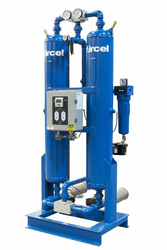
Air Compressor Desiccant Dryer Fundamentals Every …
Posted by AVP on Apr 29th 2026
An air compressor desiccant dryer is what we reach for when “normal dry air” isn't enough and the risks become uncomfortable. We are talking labs, clean rooms, winter-exposed piping, paint lines that cannot afford a single fish eye on a panel. Once you have seen what moisture really does inside a system, you do not forget it.
We work with plants and labs that live with compressed air every day. Some of them find out the hard way that water always wins if you let it.
What An Air Compressor Desiccant Dryer Really Does
Refrigerated dryers offer limited moisture removal, achieving dew points just above freezing, suitable for general air but inadequate for high purity or sub-zero needs.
Desiccant dryers solve this by passing air through media like activated alumina or silica gel, which adsorbs water, achieving dew points of -40° or lower. This eliminates the risk of ice-related issues.
The dryers use twin towers: one dries the air while the other regenerates—allowing for continuous operation.
Why the Regeneration Method Decides Your Costs
Heatless dryers, while simple, waste about 15% of the dried compressed air as purge, venting it through the offline tower.
Heated and blower-purge styles drastically reduce this purge by using electricity or a small blower instead of high-pressure air. This means trading simple hardware for less wasted air and significant energy savings on large, continuous systems.
The choice isn't theoretical; it depends on system size, operating hours, and whether the initial capital cost or the continuous waste of energy is the greater concern.
What Oil Free Units Bring to Precision Work
On the lab and clinic side, we lean on compact oil free packages all the time. Our Panther Oil Free Mini Air Compressors are built for that world. No lubricating oil in the compression chamber, so there is no risk of oil in the air stream that can poison a column or contaminate a sample.
Pair that with the optional built in air compressor desiccant dryer and you get a turnkey source of clean, very dry air right at the point of use. For three to eight cubic feet per minute, heatless regeneration makes sense. The purge loss is small, the footprint is small, and the whole package can sit in the same room as the instruments it feeds.
Panther Silent Air Compressors offer quiet, oil-free operation with low sound and vibration. They are perfect for use near sensitive equipment (such as microscopes and balances) or for personnel needing focus. The compressors run on demand, stopping on pressure until the next cycle, provided maintenance is followed.
How High Volume Pushes You to Rotary Screw
Once the air demand climbs and the duty cycle goes to full time, small piston machines tap out. That is when we start talking about Rotary Screw Air Compressors. Oil-injected screws are built to sit in a mechanical room and run for hours at a time with stable discharge temperature and stable flow.
In that setup, the air compressor desiccant dryer usually sits in the main header, just downstream of cooling and primary filtration. It handles the whole plant or at least a large production area. Heatless regeneration might make sense on a small screw system. Once you get into the thousands of cubic feet per minute, heated or blower purge is almost always the smarter move because purge loss at that scale is real money.
From there, we often add small point-of-use dryers in front of the most sensitive loads. Paint booths, packaging lines with direct product contact, and analytical labs tied into the plant utility. One big central dryer to keep the network dry and clean, then small precision units where the spec is tighter.
Choose The Setup that Works for The Long Haul
So, where does this leave you? If you are running a lab, a dental clinic, a university bench, anything where noise and oil risk are both unwelcome, an oil-free mini platform with an integrated air compressor desiccant dryer is usually the right call. You get Class one style moisture control, no oil in the airstream, and the system can sit right where you need it.
If you are running a plant with long headers, winter exposure, or high-compliance production, the conversation shifts to rotary screw plus a properly sized regenerative dryer. Then we sketch the real flow, real temperatures, and real duty cycle, and work out which regeneration style yields the lowest total cost over the life of the system. Not just the cheapest quote this month.
This is what we do every day at Air & Vacuum Process, Inc. We look at how you actually use your air, where moisture hurts you the most, and which combination of compressor and dryer will keep you out of trouble for years, not just through the next audit.