Specialty Gas Purification: High-Flow Argon, Heliu…
Posted by AVP on Nov 17th 2026
Most specialty gas purification failures we troubleshoot don’t start inside the dryer. They start in the tubing, fittings, and regulators between the dryer outlet and the torch, furnace, or analyzer. A team reads a good dew point at the dryer, signs off, and assumes the gas arrives just as dry. With argon, helium, and hydrogen moving at high flow, that assumption breaks down in a few predictable ways. Each one costs you weld quality, furnace yield, or a moisture spec you’ve promised a customer.
Measure Specialty Gas Purification Where the Gas Gets Used
Your dryer outlet reading tells you what the dryer did. It doesn’t tell you what reached the process. Every component downstream can add water back into the stream. Polymer tubing lets water vapor permeate through its walls, so a long run of nylon or polyethylene line can raise the moisture content of very dry gas before it reaches the point of use.
Threaded fittings, quick connects, and regulator diaphragms hold moisture on their surfaces after maintenance or a line opening, and they release it slowly over hours or days. If your specialty gas purification plan only checks one point, you’re grading the dryer and ignoring everything after it.
Take readings at the dryer outlet and again at the farthest point of use. The gap between those two numbers tells you whether the problem sits in the dryer or in the distribution line.
Expect Helium and Hydrogen to Find Every Leak
Helium and hydrogen are the two smallest molecules you’ll ever put through a gas line. Leak detection crews use helium for exactly that reason, since it escapes through gaps that hold back almost everything else. A leak that lets helium or hydrogen out also lets moisture in.
Water vapor moves from high partial pressure to low partial pressure, and the air around your line carries far more water than the gas inside it. Back diffusion pushes moisture into the line through small leaks even while the line runs at positive pressure.
Anyone feeding high purity gases into a gas chromatograph feels this first. Moisture in helium or hydrogen carrier gas degrades column stationary phases at temperature and raises baseline noise.
Analytical instrument protection depends on the last few feet of line as much as it depends on the dryer. When your specialty gas purification results look fine at the outlet and wrong at the instrument, leak check every fitting in between before you blame the desiccant.
Size Adsorbent Purification for the Flow You Actually Run
High flow cuts the time the gas spends in contact with the desiccant bed, and adsorbent purification depends on that contact time. Push more gas through the same bed and the mass transfer zone stretches out, so moisture breaks through sooner than the dryer’s rated cycle suggests.
Molecular sieves hold water at much lower partial pressures than silica gel or activated alumina, and most gas purification systems that need very low dew points use them in the final bed. They still saturate. If you sized a bed for 200 SCFM, it won’t hold the same dew point at 350 SCFM.
Purge gas adds another cost. Heatless regenerative dryers typically spend around 15 percent of their flow on purge, and with helium, that loss shows up on your gas bill fast. Our overview of regenerative desiccant air dryers walks through how the two towers trade off between drying and regenerating. Upstream, the right filters for gas dryers keep particulate and liquid carryover from fouling the bed. Check that your specialty gas purification setup still holds its dew point at peak demand, not only at average flow.
Know Which Dew Point Your Spec Actually Means
Dew point changes with pressure. Gas with a minus 40°F pressure dew point at 100 psig shows a much lower dew point once you expand it to atmospheric pressure.
Many purity specs skip dew point entirely and state moisture in parts per million. ISO 14687 limits water in fuel cell hydrogen to 5 ppm. At atmospheric pressure, 5 ppm works out to a frost point of roughly minus 86°F. Gas at minus 40°F atmospheric dew point carries about 127 ppm, more than 25 times that hydrogen limit.
Ultra-high purity gas for semiconductor and laboratory work often runs tighter still. Before you pick a meter or judge a reading, confirm whether the spec means pressure dew point, atmospheric dew point, or ppm by volume. Mixing those up is one of the most common reasons a specialty gas purification system passes on paper and fails at the customer’s inlet.
Use a Handheld Meter and a Fixed Transmitter for Different Jobs
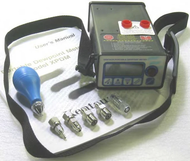
Dew point measurement at more than one spot calls for two kinds of instruments. A handheld meter like the COSA XPDM handles spot checks. You carry it to the dryer outlet, the manifold, the farthest drop, and any fitting you just replaced, and you get a reading in minutes instead of waiting days on a lab sample. The XPDM reads down to minus 148°F (minus 100°C), which leaves plenty of room below the 5 ppm hydrogen fuel limit.
A fixed transmitter like the COSA XDT-XT65 watches a single point around the clock. It reads from minus 85°F to 68°F, so it catches desiccant breakthrough on argon, helium, and hydrogen lines as it happens. Its lower limit sits right at the 5 ppm threshold, so use the XPDM to verify fuel grade hydrogen.
Good specialty gas purification programs use both, with the handheld finding problems and the transmitter watching for them. Distributors such as Air & Vacuum Process list both formats side by side, which makes it easier to match the range to your gas and your spec before you buy.
Build Specialty Gas Purification Checks Into Your Maintenance Routine
Take a handheld reading at the dryer outlet and at the farthest point of use every time you change a cylinder, open a line, or replace a fitting. Log the transmitter readings and watch the trend instead of the single number, since a slow upward creep usually means the bed is nearing breakthrough. Plan media changes around that trend.
Consolidating your desiccant sourcing for air and gas keeps replacement media on hand, so a saturated bed doesn’t take a line down for a week. Treat gas contaminants as a distribution problem as much as a dryer problem, and check both. Two readings in the right places tell you more about your specialty gas purification than any dryer spec sheet.