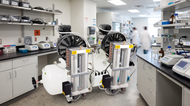
26-Gallon Air Compressor Benefits for Research and…
Posted by AVP on Oct 28th 2026
A 26-gallon air compressor gives research and medical labs clean, steady air without the cost and footprint of a central plant system. Lab managers buy one to serve a single room, a cluster of instruments, or a building that never had piped air. The right unit protects your samples, your equipment, and your schedule. The wrong one brings oil, water, and noise into a space that can’t tolerate any of them.
Below, we use the PC2x2/100 Panther as the reference unit and lay out what your lab should check before you buy.
Keep Oil Out of Samples With an Oil-Free 26-Gallon Air Compressor
Oil-lubricated compressors push microscopic oil aerosols into the air stream. Those aerosols travel downstream until something stops them, and in a lab that something is usually a sample, a sensor, or a pneumatic valve. ISO 8573-1 sets purity classes for oil, water, and particles in compressed air because trace contamination changes results.
An oil-free air compressor removes oil from the process entirely. The PC2x2/100 runs two oil-less PC2 pumps in a tandem configuration, so no oil enters the air at the source. Downstream filters only protect you until they saturate or someone misses a change. With an oil-free 26-gallon air compressor, you start every cycle with air that never touched oil, and you drop oil carryover from your maintenance checklist.
If you’re replacing an older oil-lubricated unit, inspect the existing piping too. Residual oil can sit in old lines and keep reaching instruments long after the new compressor goes in.
Dry the Air Your 26-Gallon Air Compressor Sends to Instruments
Compressed air carries water vapor, and that vapor condenses as the air cools. Wet air corrodes valves, swells seals, and throws off instruments that need a stable dew point for repeatable readings. In medical labs, standing condensate in tanks and piping also gives microbes a place to grow, a risk facility teams already watch for in clinical air systems.
The Panther handles moisture in stages. An integrated aftercooler drops the air temperature right after compression and pulls water out before it reaches your lines. A 5 micron particle filter with an autodrain catches particles and empties collected condensate on its own, so nobody on your team has to remember to open a drain valve. Air compressor tank size matters here, since a bigger tank holds more condensate along with more air.
For work that calls for very dry air, the optional self-regenerative desiccant dryer takes your 26-gallon air compressor the rest of the way. Pair the dryer with a dew point meter. Desiccant saturates over time, and readings drift without anyone noticing until results start to wander.
Fit the Compressor Into Shared Lab Space
Benches, fume hoods, freezers, and instruments claim lab floor space first. A 26-gallon air compressor like the PC2x2/100 measures 53 x 26 x 34 inches and weighs 149 lbs, small enough for a utility closet or the corner of a prep room next to the space it serves. When your lab reorganizes, you can relocate it far more easily than a fixed plant system.
Noise counts just as much. The unit runs at 72 dB/A, lower than most compressors at this output, and a closed door between the compressor and the bench cuts that further. Artists who airbrush in shared studios look for the same thing, because constant compressor noise wears on everyone in the room.
Placing a laboratory air compressor close to the work also shortens your pipe runs. Shorter runs mean fewer joints that can leak and less line where condensate can settle.
Protect Your Uptime With Warranty, Support, and Sourcing
When a 26-gallon air compressor fails in a lab, the repair bill is the smallest cost. A failure can stall an experiment mid-run, spoil samples that depended on steady air, and push back project deadlines. The tandem design on the PC2x2/100 splits the work between two pumps, and the tank gives them time to rest between cycles, which reduces wear on each one.
Support matters as much as hardware. The Panther comes with a 12-month warranty and dedicated tech support, so your facilities team has someone to call who knows the unit. Buy from a supplier that also stocks the compressed air dryers, filters, drains, and dew point meters that sit around the compressor. Air & Vacuum Process, for example, carries Panther compressors alongside Van Air and PureGas dryers, so a lab can build and service its full air system through one account.
Size a 26-Gallon Air Compressor to Your Lab’s Actual Demand
Start with CFM. Add up the air consumption of every instrument and tool on the line, then leave margin for equipment you plan to add. The PC2x2/100 delivers 12.7 CFM of free air (360 liters per minute) at a max pressure of 116 PSI, or 8 bar. If your total runs higher, the PC3x2/100 puts out 17.08 CFM on the same size tank.
Check your electrical next. The PC2x2/100 runs on 220V single phase power and draws up to 14 amps, so confirm the room has a suitable dedicated circuit before delivery day. Then match the dryer decision to the dew point your instruments specify. Bring all three figures to your supplier, and you’ll get a straight answer on fit in one call.
Get those numbers right (CFM, power, and dew point), and you’ll know exactly what your lab needs from a 26-gallon air compressor.